Cherokee Prairie

Cherokee Prairie

Each spring, I look forward to visiting Cherokee Prairie, an Arkansas Natural Heritage Site. There are a number of pieces of land in Arkansas similar to this; allowed to grow naturally, with only foot traffic allowed.
This spring, I’ve been able to make several visits to the Prairie, and here’s some of what I’ve seen – and photographed.
Among the first wildflowers to bloom is Indian Paintbrush. I visited once and they were just beginning to show color; a later visit and the Prairie was nearly covered with the colorful red flowers.

Indian Paintbrush (Castilleja coccinea), Cherokee Prairie, near Charleston, Arkansas

Indian Paintbrush (Castilleja coccinea), Cherokee Prairie, near Charleston, Arkansas

Then, in the midst of the red flowers was this yellow version.


A yellow version of Indian Paintbrush

A yellow version of Indian Paintbrush


Here’s another image (my favorite) of the same yellow flower, juxtaposed with the red ones in the background.
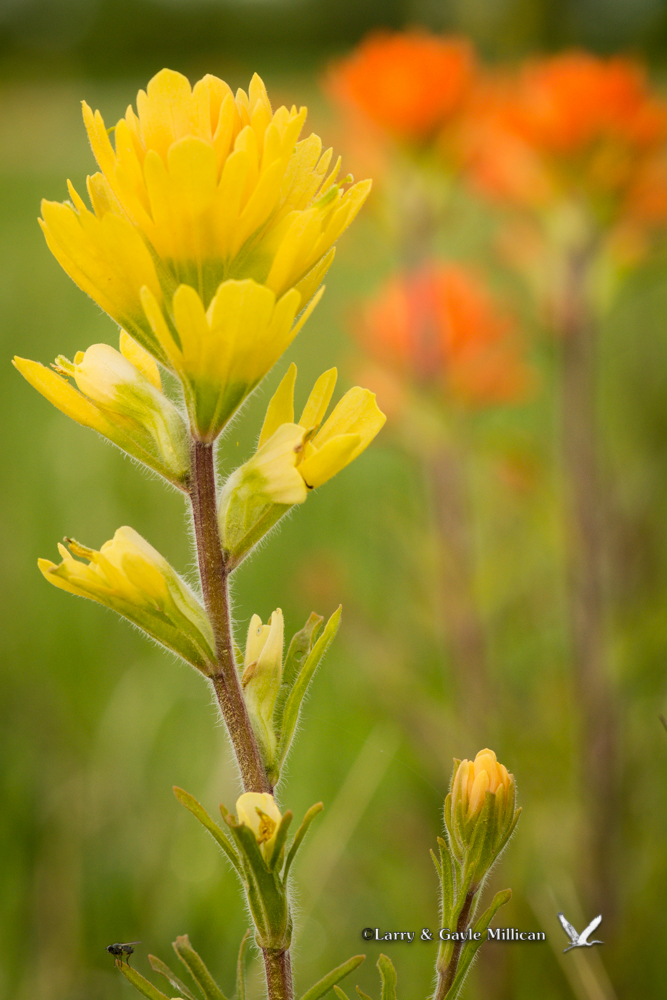
Yellow Indian Paintbrush, Cherokee Prairie near Charleston, AR

Yellow Indian Paintbrush, Cherokee Prairie near Charleston, AR


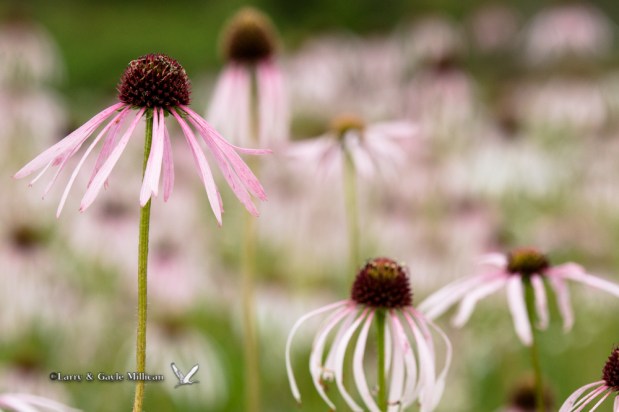
Next, a few weeks later, the Purple Coneflowers covered the Prairie:

Purple Coneflower Duo

Purple Coneflowers (Echinacea purpurea), Cherokee Prairie, Charleston, Arkansas


Purple Coneflower 03689

Purple Coneflower framed by Doll’s Daisy, Cherokee Prairie, Charleston, Arkansas

Large patch of Purple Coneflowers, Cherokee Prairie, Charleston, Arkansas

Large patch of Purple Coneflowers, Cherokee Prairie, Charleston, Arkansas


There are other wildflowers there; these are some of my favorites.

And, the visitor can also see some other “flying flowers”, such as this Eastern Tailed-Blue.  This was a first for me, and I appreciate our friend, Anne Sayers, helping identify it…

Eastern Tailed-Blue, Cherokee Prairie, Charleston, Arkansas

Eastern Tailed-Blue, Cherokee Prairie, Charleston, Arkansas


These images were all made with the Sony Alpha77, a Minolta 100mm macro lens and, more recently, a Tamron 180mm macro lens, Manfrotto tripod and Really Right Stuff ball head.  And, all the water drops were there before I was…  🙂


Black Bass Lake

Every two years, the Photographic Society of Northwest Arkansas (www.psnwa.org) hosts the Mid-America Photographic Symposium (MAPSYM). This year, for the first time, I was able to attend the weekend event, held in Eureka Springs, Arkansas. Kudos to the PSNWA for putting on a first-class event, aimed at photography enthusiasts and professionals alike.

One outing I joined was an early morning “Nature Hike” at Black Bass Lake.  Even if you’ve ever been to Eureka Springs, a small community built on a steep hillside, I doubt you’ve heard about this lake. At least, I hadn’t, and I overheard another participant, from the area, say the same thing.  So, we drove down a steep hill on a gravel road, to the lake, and it was like going to another world; right in the middle of the community, we were suddenly in a wilderness.  It was so cool! (Are we supposed to say “cool” any more? I can’t keep up, so I just say what I feel.)
The morning was typical spring for this area; cool and damp. The lake had some misty fog hanging over the surface, and fortuitously, there were two fishermen in a small boat…

Two fishermen on Black Bass Lake, in the misty fog.

Two fishermen on Black Bass Lake, in the misty fog.


Walking one of the trails around the lake, I photographed this C-curved blade of grass, with a dew drop hanging on.  Those that know me, and especially those that have sat through a class with me, have heard me stress simplicity…

C-dew drop

Dew drop clings to a curved blade of grass, alongside Black Bass Lake, Eureka Springs, Arkansas


There were also a number of these purple flowers; according to Don Kurz’s Arkansas Wildflowers book, it’s called the Leather Flower.  Cool flower…

Leather Flower (Clematis versicolor)

Leather Flower along Black Bass Lake, Eureka Springs, Arkansas


So, it was an interesting weekend.  I learned a bit about how Hanson Fong takes portraits, saw & listened to Nikon’s Mark Kettenhofen deliver an awesome keynote presentation, and more.  Glad I went.  🙂


Camera used was the Sony Alpha 77, Sony 16-50 f/2.8 (I love this lens!) and Minolta 100 macro, Manfrotto tripod with Really Right Stuff ball head.


Garvan Woodland Gardens

In April this year, I visited Garvan Woodland Gardens, in Hot Springs, Arkansas.  My first time there, although it is a place high on my want-to-go-to list for some time.  Mid-April was a little late for the tulips, which are reportedly spectacular, but there was still lots of colorful flowers covering the grounds.

So here are a few selected photos.  Hope you enjoy!

Rhododendrons by the waterfall.

3064WaterfallAndRhododenrons

Garvan Woodland Gardens, small waterfall with rhododendrons.

Some remnants of tulips in front of red flowers (no – I don’t remember what they are.)

Tulip remnants with red flowers in the background.

Tulip remnants with red flowers in the background.

Along a path, there was a late blooming river of tulips.

A River of Tulips

A River of Tulips


Here is a tight crop of the tulips from the “river.”

The river of tulips, Garvan Woodland Gardens, Hot Springs, Arkansas

The river of tulips, crop, Garvan Woodland Gardens, Hot Springs, Arkansas

Closeup of rhododendrons.

Closeup of some rhododendrons, Garvan Woodland Gardens, Hot Springs, Arkansas

Closeup of some rhododendrons, Garvan Woodland Gardens, Hot Springs, Arkansas


The Gardens have flowers in bloom throughout the spring and summer, but are well known for their tulips displays in early spring.  Maybe next year…

Photos were all taken with the Sony Alpha 77, and the Sony 16-50 f/2.8 lens and the Minolta 100 f/2.8 macro lens.


High Island, Texas

About 30 miles east of Galveston is the small town of High Island. Although it is a small community, birders the world over know the name. The Houston Audubon Society has converted a large portion of the town into a sanctuary, with wooded areas, and a heron rookery, and each spring, the area fills with migrating songbirds. The High Island Sanctuaries are a definite visit when we travel to the area.

Southeast Texas map

Southeast Texas map

In April, the rookery fills with Great Egrets, along with cormorants, eye-catching roseate spoonbills, and tri-colored and night herons, mating and building nests. For birders and especially photographers, the good news is the rookery is on an island about 20 yards from the pond banks. The pond, called “Claybottom Pond” is filled with alligators, making the island safe from predators such as raccoons; but of course, if any birds get too close, they make a meal for a hungry alligator!

For an unknown reason, this Great Egret pair was nesting a bit later than most of the others; the male would fly away and come back with nesting material, then present it to his mate, who would add it to the nest.  In this photo, his raised wing seems protective and caring.  I think I was fortunate to capture this moment; it’s one of our favorite photos…

Great Egrets build their nest

A Great Egret pair works together to build their nest at The Rookery, High Island, Texas


Sony Alpha 100, Tamron 300 f/2.8 with Tamron 2x teleconverter, Manfrotto tripod


Red Reflections

I first saw reflections in water drops in a magazine – probably Outdoor Photographer.  The photos were fascinating, and I decided it was a subject/technique I needed to learn.  There were a number of failures over the years, until this photo.

On the day I took this, I was visiting Cherokee Prairie Natural Area.  In fact, I had been there for a while, searching the Prairie for just the right combination of water drops, grass tangles, flowers, and light.  I had no success, and was walking back to my truck, when at the very edge of the parking area was a perfect arrangement.  I set the tripod up in the short grass of the parking area, and made a number of exposures…

One of the problems with making these photographs is that all of the vegetation – grass, flowers, shrubs, briars – is connected!  Setting a tripod up without causing the water drops to fall is sometimes impossible.  Often, I get it almost just right, move the tripod – or the camera & lens – and bump or pull something, causing the water drops to disappear.  So, finding this at the parking lot was exciting!  Ever since that day, I always look around the parking area before heading off into the grasses of the prairie…

Wild rose reflected in water drops on grass

Wild rose reflected in water drops on grass
Cherokee Prairie State Natural Area, near Charleston, Arkansas

I have always like the sharpness of this image, but would like to have the same situation again; I think it deserves some different compositions, and would like to shoot it with one of today’s higher resolution cameras.  However, photographs are the reflection of a moment, then it’s history.  As much as we might wish to relive our past, we cannot…  😉


Minolta Maxxum 7D, Minolta Maxxum 100 mm macro lens, Manfrotto tripod.

Reflections

Each spring, I look forward to going out to locate, and photograph dew drops reflecting, preferably, a wildflower.  Of course, any breeze, even one barely felt on skin, is the enemy.  So, we hope for no breeze, large dew drops easily photographed, and a colorful wildflower behind…

On this morning, I found a spiderweb covered in dew, and in the background was a black-eyed susan wildflower.  However, there was a nearly imperceptible breeze – just enough to move the spiderweb.  I took several photos, trying to time the exposure for the least movement.  Here is one of the best, but because of the air movement, I was unable to keep all in sharp focus.

Dew drops on a spider web reflect the black eyed susan flower in the background.

Dew drops on a spider web reflect the black eyed susan flower in the background.


I took this photo at Cherokee Prairie Preserve State Heritage Site, near Charleston, Arkansas, using the Sony Alpha 700, the Minolta 100 mm macro lens, Manfrotto tripod.  The shutter speed was 1/320th second, in an attempt to freeze the movement from the breeze, at f/8.

Christmas Honors

Christmas Honors

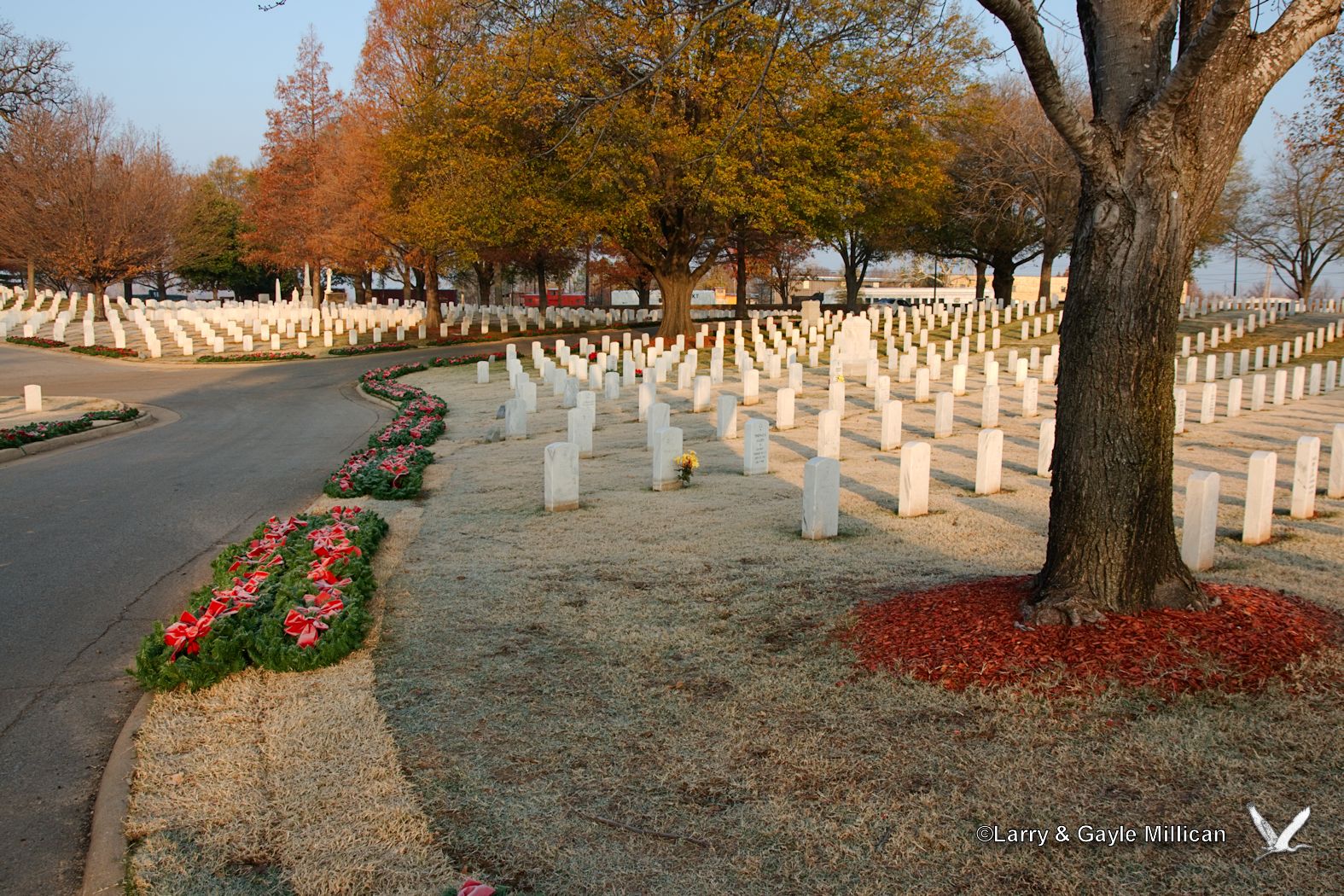
In 2009, the Fort Smith Chamber of Commerce started a program to honor the veterans buried in the Fort Smith National Cemetery.  Inspired by Arlington National Cemetery and “Wreaths Across America,” the goal was to lay a Christmas wreath upon each grave in the cemetery.  It has been a huge success.  The community has joined together and each year, over 1,000 volunteers have assembled the wreaths in a remarkably short period of time, then the veterans’ families, scout troops, veterans groups, and Jr ROTC units have placed the wreaths on the graves.

Most of the photos shown here are from 2011, and one from 2009.

Wreaths by the road

After being assembled, the wreaths are placed in groups along the cemetery road, waiting to be placed on the graves. Family members are the first to place the wreaths, and everyone allows them time alone with their departed loved ones.

Wreaths were covered with frost

That morning in December 2011, was very cold, and the wreaths and red ribbons were covered with frost

An area of Unknown Soldiers' graves

In an area of Unknown US Soldiers’ graves, local Jr ROTC troops place the wreaths

Jr ROTC trooper salutes the grave of an unknown

After placing the wreath on the grave of an Unknown US Soldier, the young cadet salutes the grave headstone, to honor the fallen

Snow on the Wreaths

In 2009 – the first year for Christmas Honors – we received a snowfall on Christmas Day.
Understand this… it never snows on Christmas Day in Fort Smith, Arkansas. 🙂
This is only one of probably at least a hundred thousand photos taken before the snow melted…

These are only a few photos, and others have taken more and better.  But, this is a story about a community that came together and worked together to honor our fallen brothers and sisters.  I think it’s a good thing they’ve done…

About “The Wall”

In 1968, we still believed, for the most part, that our country was right to be in Vietnam.  We were helping protect the world against communism.  At least in Oklahoma, we still believed.  My duty was to serve my country.  I still would.

At that age, I was still searching for myself.  (Yes, I know some people think I still am!)  But after spending the summer working, my cousin Ron Gifford convinced me I should join the Marines.  And in doing so, I did him a favor, because he got an extra 5 days or so leave because he referred me to enlistment!  🙂  At that time, I could enlist for a 2-year commitment, and I did.  Went to San Diego for boot camp, then on to Camp Pendleton for infrantry training, and artillery fire direction training.  Came home for a couple weeks, then back to California, and on to Vietnam.  By that time, our thoughts were not so much of glory, but fear and hoping to stay alive…

I did my year in country, and came home safe.  (By the way, I never gave much thought, I’m ashamed to say, about how this affected my mother – until my son, Ryan, was deployed to Kuwait a few years ago.)  A chapter in my life closed.  I never forgot my “tour of duty” but it did not occupy my thoughts either.

In 1992, we visited daughter Michelle in Indiana.  On the trip home, we detoured through Springfield, Illinois to see Abraham Lincoln’s tomb.  Glad we did, but in the same cemetery is the Illinois State Vietnam Veterans Memorial.  We had no ties to Illinois, but forgotten emotions came up, and I began to realize how much so many of us gave.  I came back, but 58,000 others did not…

The next year, we visited Washington, D.C., and The Wall – the National Vietnam Veterans Memorial.  To stand there, and look at the names, to listen to the silence, to see people “rubbing” a pencil copy of someone’s name, to see the momentos left behind, again I thought, “I came back.”

So, this photo.  Not a great job, but I believe I took it at the right angle – to see the 3 Servicemen watching the visitors at The Wall.

This photo was shot with film, scanned with a Kodak CD scanner.  Wish I could do it over with digital… and I may some day.

Today, I put a crop from this on my Facebook Timeline, and several people have already noticed it, “liked” it and commented.  This is my backstory.  Sorry to be so long-winded; hope you read this, and understand…

The Wall

September, 1993

Fort Smith Park Autumn

After record breaking heat in the summer of 2011, many of us, including me, did not expect much in the way of “color” in the fall.  However, we were pleasantly surprised and had a very colorful fall – one of my favorite seasons.

Autumn in Arkansas and Oklahoma is brief, and each year brings a different look.  Occasionally, as in 2009, we’ve had an unusually wet fall, giving us water falls, and flowing streams to complement the color.  But, more often, it’s a relatively dry season.  It’s a time of change, and a photographer is challenged to be at the right place at the right time to make an image to represent the season.

On this morning, I was driving to work, but had left home early enough to stop if I saw the right scene, in pleasant light.  Here’s one image I stopped to make.  Initially, I pointed my camera toward the just-risen sun, but that wasn’t the image I wanted.  So, I turned around, and saw the clouds, the sky, the yellow leaves, and the tree line.

What you see here, was shot as a RAW file, cropped slightly to rid the image of a light pole on the right, and some pavement on the left.  Using Corel After Shot Pro, and Corel Paint Shop Pro X4, I’ve adjusted color balance, levels, and sharpness.  Camera was the Sony Alpha 700, with a Tamron 17-50 f/2.8 lens.  Exposure was 1/250 sec. at f/5.6, ISO 200.

Fort Smith Park is on Wheeler Avenue, just west of Midland Boulevard in Fort Smith, and includes numerous picnic tables, a boat ramp to the Arkansas River, and is visited by a large number of area residents throughout the year.  It’s an old park, with old trees; a park I often visit for photographs, and I’m seldom disappointed…

Fort Smith Park Autumn

November 2011

Dogwood Blossoms

After photographing the cattle in the morning fog (see “Pastoral Morning“), I continued south on Highway 71.  But, since I had a late start – at least, later than intended – and I had stopped for the cattle photos, I knew I wouldn’t have the good early morning light on the Cossatot.  So, I decided to explore a bit.  (Exploring is good!)

Despite having driven this way many times, I had never been to Lake Hinkle, near Waldron.  I took the road to Hinkle Dam, and found it a very pleasant & pretty drive, with a stream alongside the road much of the way, farms and farmland, and woodlands with dogwoods blooming.

After visiting the dam & the lake, I stopped on the return trip near a patch of dogwoods.  From the road, there was a slight slope down to the stream, so the dogwood trees were at eye level or slightly below.  Perfect!  In addition, most of the area was in shade.  I couldn’t have asked for much better conditions.

Here are a couple of the dogwood images:

“Dogwood Parade” looks like the blossoms are lined up ready to say “look at me!  look at me!”  I like the dark background, but wish the stems & branches behind the blossoms weren’t so noticeable.

by the numbers:  Sony Alpha 77, Minolta 70-210, f/4 @ 1/200 sec, ISO 200

The next image, “Dogwood Song”, really does sing to me – or maybe makes me want to sing, which is not a good thing.  I shot again at f/4, to limit the depth of field, leaving the most predominant blossom the sharpest, and the others gradually getting softer.  Camera & lens the same…

Feel free to offer your opinion as to which you prefer.  Comments are certainly welcome…

Next time, we’ll discuss another image from another time…

Larry